Same Building, Different Light
Photography gives back something difficult to name. For me, photographing buildings brings an intimacy with the subject that is hard to explain in words.
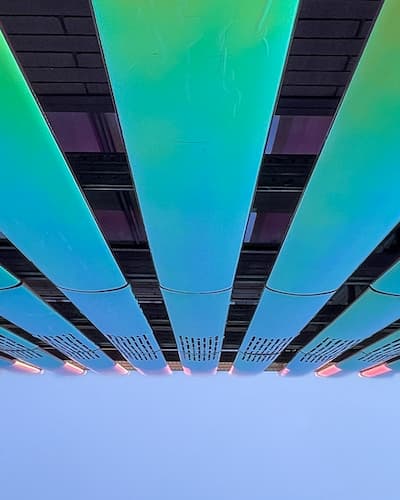
I had walked past this one before without really seeing it. It was only when I stopped to photograph it, getting close, shifting position, looking up from below, that its multiple dimensions revealed themselves. The panels shift. Green shifts into teal, teal into blue. Not because of any special effect, but because the building's iridescent surface responds to angle, light, and time of day. The same structure, completely transformed depending on where you stand when you look.
David Epstein's book Range raises something that my experience photographing this building links in with.
The world we are moving into is increasingly defined by what Epstein calls wicked problems. Complex, non-repeating challenges that require broader thinking and experience than a specialist alone can offer.
Specialization still matters. But alongside it, there is a growing need to hold multiple perspectives, draw connections across domains, and approach problems from multiple angles.
This is where the human advantage over AI may still exist. AI excels at pattern recognition within established domains, optimizing within a known frame. What it cannot do is question the frame itself, or generate the kind of original thought that comes from lived, cross-domain human experience. One of the human edges we have left.
And yet the structures around us are built in the opposite direction.
Think about any selection process you have encountered, in education, in careers, in institutions.
All are exercises in reducing uncertainty and predicting outcomes, with incentive structures built around exactly that. The logic is rational.
Epstein provides a study that demonstrates this tendency toward the familiar.
Across millions of scientific papers, research combining fields rarely cited together was consistently overlooked, published in lower-prestige journals, ignored on arrival. But tracked over fifteen years, those same cross-disciplinary papers climbed to become among the most cited work in their fields. The combination the system discouraged turned out to be the one that lasted.
While Epstein and others point to experimenters and samplers, Nobel laureates, musicians, scientists with wide-ranging interests, as evidence of the value of breadth, the harder question remains. Is this enough to shift anything when broader structures continue to incentivize the opposite?
Which brings me back to this building.
It doesn't reveal its full range of colour to everyone who walks past.
Only to the person who chooses to stop, get close, and shift their angle.
The building holds that possibility for everyone. But whether people are given the conditions, the time, and the incentives to look differently is rarely down to the individual alone.
In a world oriented around efficiency and specialization, it is a conscious choice that runs against the current.
What it requires is not just individual will but structures and systems that can keep pace with a world being reshaped by AI.